The Roots of Representation: Dismantling Bias in K-12 STEM Before It Shapes a Generation
Every year, universities across the United States launch diversity initiatives, broaden scholarship programs, and host recruitment fairs designed to attract underrepresented students into science, technology, engineering, and mathematics. These efforts are well-intentioned and, in many cases, genuinely effective. Yet they share a common blind spot: they intervene too late.
By the time a first-generation Latino student or a Black girl from rural Mississippi receives a college recruitment brochure, years of subtle discouragement, resource inequity, and unchecked bias have already done their work. The so-called "pipeline problem" in STEM is not primarily a failure of higher education recruitment. It is a failure rooted in the very first years of formal schooling.
The Numbers Tell a Story That Cannot Be Ignored
According to the National Science Foundation's most recent data on STEM participation, Hispanic, Black, and Native American students collectively represent fewer than 15 percent of science and engineering bachelor's degree recipients — a figure that has moved only marginally over the past two decades despite sustained national attention. Meanwhile, the U.S. Census Bureau projects that by 2044, non-Hispanic whites will no longer constitute a majority of the American population.
The disconnect between demographic reality and STEM representation is not accidental. Researchers at Stanford's Center for Education Policy Analysis have documented that Black and Latino students are systematically underenrolled in advanced mathematics courses as early as middle school — not because of aptitude deficits, but because of tracking decisions made by teachers and counselors who carry implicit biases about who belongs in rigorous academic settings.
"When a child is told at age eleven that they are 'not a math person,' that message doesn't evaporate," says Dr. Carmen Reyes, a science education researcher and former middle school teacher in Chicago's South Side. "It calcifies. And it calcifies precisely in the students who most need encouragement, because they have fewer people at home who can counter that narrative."
Unconscious Bias in the Classroom: Invisible, Consequential, and Measurable
Unconscious bias in education manifests in ways that are difficult to detect in any single interaction but devastating in aggregate. Studies published in the American Educational Research Journal have shown that teachers — regardless of their own racial or ethnic background — tend to call on boys more frequently than girls during science lessons, provide more detailed feedback to students perceived as academically promising, and recommend students from majority backgrounds for gifted programs at higher rates than equally qualified minority peers.
These micro-interactions accumulate into macro-outcomes. A student who is overlooked in class discussions learns to be silent. A student who is never recommended for an enrichment program never discovers a passion for chemistry. A student who is steered toward vocational tracks instead of AP courses loses the foundational preparation required for a STEM major.
"We talk about the leaky pipeline," says Marcus Webb, a high school physics teacher and SACNAS member in Atlanta, Georgia. "But a lot of those leaks are drilled by the adults in the building, not by the kids themselves. The kids are ready. We just keep handing them the wrong tools."
The Resource Divide Compounds the Bias Problem
Underfunded schools — which disproportionately serve Black, Latino, and Indigenous communities — often lack the laboratory equipment, qualified science teachers, and extracurricular enrichment programs that make STEM tangible and exciting for young students. A student who has never conducted a hands-on experiment, never met a working scientist, and never seen someone who looks like them on a classroom poster of famous inventors is being asked to aspire toward a world that has given them no evidence they belong in it.
The 2015 reauthorization of the Every Student Succeeds Act did include provisions for improving STEM access in Title I schools, but implementation has been uneven at best. Federal intent does not automatically translate into district-level change, particularly when local budgets remain constrained and professional development for teachers is chronically underfunded.
Interventions That Work — and Can Be Implemented Now
The research literature on effective K-12 STEM equity interventions is more robust than many policymakers acknowledge. Several evidence-based approaches have demonstrated measurable impact:
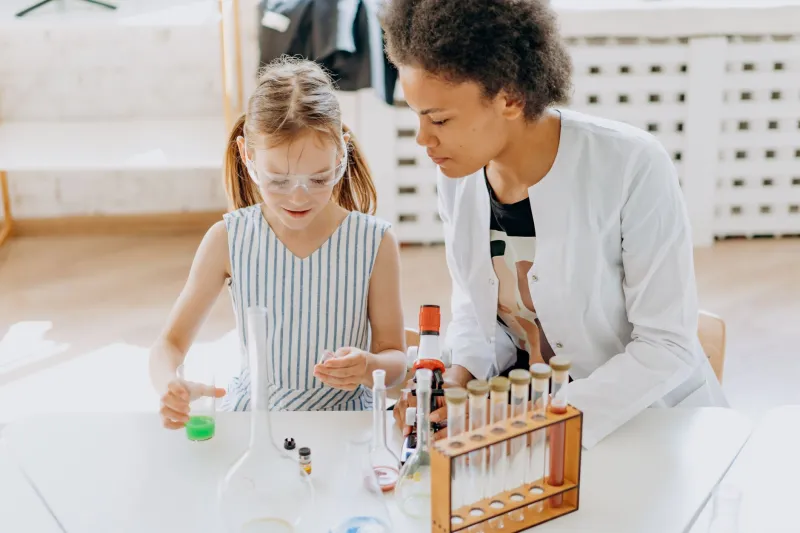
Early exposure programs that bring working scientists into elementary classrooms — particularly scientists from underrepresented groups — have been shown to shift students' self-perceptions as potential science practitioners. Organizations like SACNAS are uniquely positioned to facilitate these connections by mobilizing their membership as volunteer STEM ambassadors in local schools.
Bias-awareness training for educators — when implemented with accountability structures rather than as one-time workshops — reduces differential treatment of students along racial and gender lines. Districts in California and Massachusetts have piloted ongoing coaching models that show promise in reshaping classroom dynamics.
Eliminating rigid academic tracking in middle school mathematics, a reform championed by the National Council of Teachers of Mathematics, removes a structural barrier that has historically funneled minority students away from advanced coursework before they have the opportunity to demonstrate their capabilities.
Family engagement programs that demystify STEM careers and college pathways for parents and guardians — many of whom did not attend college themselves — build the home-based encouragement networks that research consistently identifies as critical to student persistence.
A Collective Responsibility
Scientific and professional organizations cannot afford to treat K-12 education as someone else's problem. The diversity of tomorrow's research workforce is being determined in classrooms today. When a gifted young scientist is turned away from STEM before they ever hear the word "university," the loss belongs not only to that student but to the fields of knowledge they might have advanced, the communities they might have served, and the innovations that may never come to pass.
The pipeline does not begin at the college application portal. It begins the first time a child looks at a night sky and wonders why the stars stay in place, or mixes two household substances and is startled by the fizz. Our obligation as a scientific community is to ensure that wonder is met with encouragement — regardless of the zip code, last name, or face in which it arrives.